Mastering Python: From CPython Virtual Machine Internals to High-Throughput Architecture
Python is often characterized as a friendly, beginner-oriented scripting language. Yet beneath its expressive syntax lies one of the most sophisticated runtime engines in modern computer science. It orchestrates multi-billion-dollar quantitative trading engines, powers the training infrastructure for planetary-scale machine learning models at Meta and Google, and serves hundreds of thousands of concurrent API requests per second across modern cloud architectures.
To write high-performance Python at an elite level, you cannot treat the runtime as a black box. You must understand how the compiler tokenizes source text, how the virtual machine evaluates bytecode frames, how the memory allocator prevents fragmentation, how the Global Interpreter Lock regulates thread scheduling, and how the asynchronous event loop manages I/O multiplexing.
This comprehensive guide dissects CPython from bare-metal C structures to enterprise systems architecture.
1. The CPython Compilation Pipeline: From Source Code to Bytecode
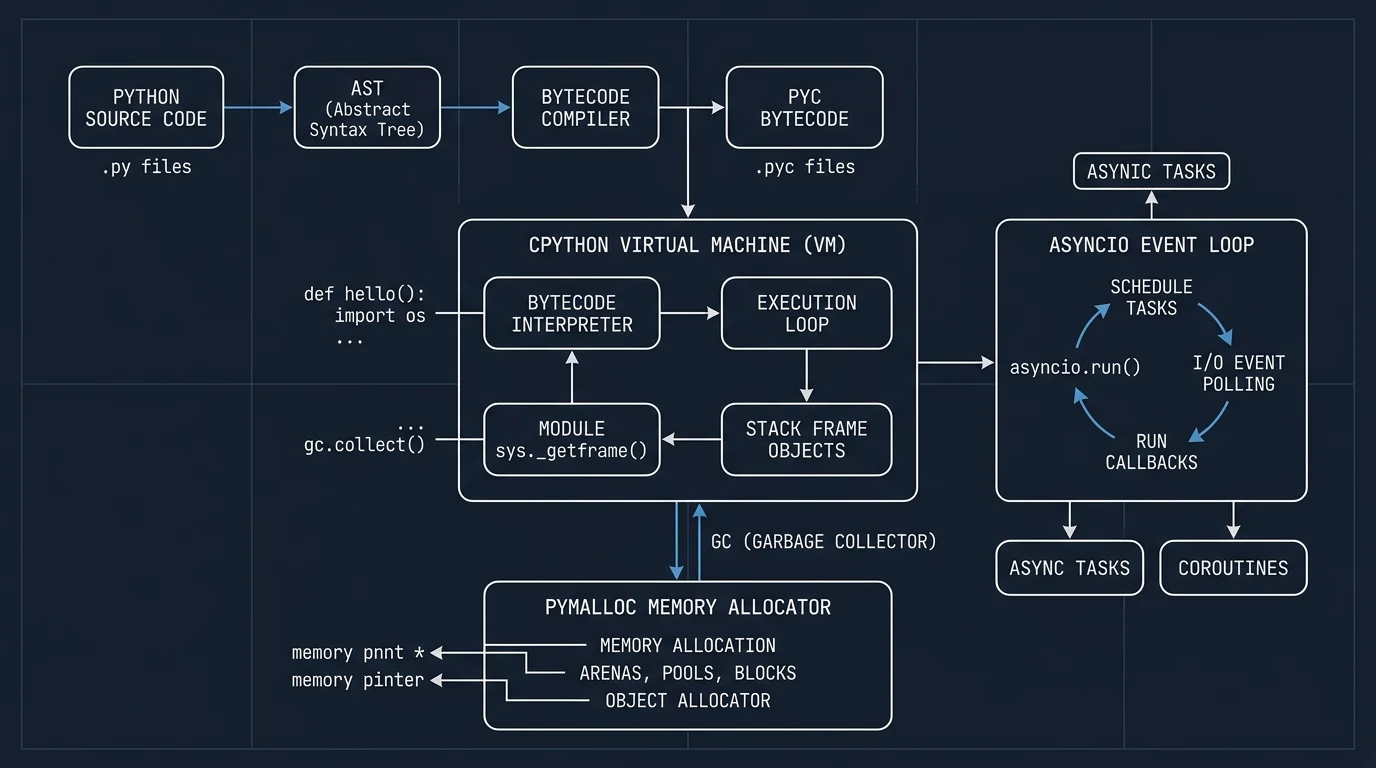
When you execute python main.py, the interpreter does not execute raw Python text line-by-line. Instead, it compiles the script into intermediate bytecode instructions executed by the CPython Virtual Machine.
The compilation pipeline operates through four discrete stages:
[Python Source (.py)]
       │
       ▼ (Lexical Analysis: tokenizer.c)
[Token Stream]
       │
       ▼ (Parsing: Parser/parser.c with PEG Grammar)
[Concrete / Abstract Syntax Tree (AST)]
       │
       ▼ (Symbol Table & Optimization: Python/compile.c)
[Control Flow Graph (CFG) & Code Object (co_code)]
       │
       ▼ (Virtual Machine Evaluation: Python/ceval.c)
[Native OS Execution on CPU]
Stage 1: Tokenization and Parsing
In Python 3.9+, CPython switched to a Parsing Expression Grammar (PEG) parser (PEP 617), replacing the legacy LL(1) parser. The PEG parser allows unlimited lookahead, eliminating unnatural language grammar workarounds and enabling structural pattern matching (match/case) without ambiguous shift-reduce conflicts.
Stage 2: The Abstract Syntax Tree (AST)
The parser produces an AST representing the hierarchical syntactic structure of the program. You can inspect this tree programmatically via the built-in ast module:
import ast

source_code = "total = sum(x ** 2 for x in values)"
tree = ast.parse(source_code)
print(ast.dump(tree, indent=2))
Stage 3: Code Objects (PyCodeObject)
The compiler transforms the AST into a PyCodeObject. A code object is an immutable container encapsulating executable bytecode instructions along with associated constants, variable names, and execution metadata:
co_code: The raw bytes sequence of opcodes and arguments.co_consts: Tuple of literal values (integers, strings, sub-code objects) used within the block.co_varnames: Tuple of local variable names.co_names: Tuple of global names and attribute identifiers.co_stacksize: The maximum depth of the value stack computed at compile time.
Disassembling Bytecode with dis
We can disassemble a function to see the exact opcodes executed by the evaluation stack:
import dis

def calculate_variance(numbers: list[float], mean: float) -> float:
    accumulator = 0.0
    for val in numbers:
        diff = val - mean
        accumulator += diff * diff
    return accumulator / len(numbers)

dis.dis(calculate_variance)
In the output, you will observe the stack-based instructions:
LOAD_FAST: Pushes a local variable onto the evaluation stack in time via an array index.LOAD_GLOBAL: Lookups a global symbol in amortized dictionary lookup.BINARY_OP: Pops two operands, applies an arithmetic operation, and pushes the result.FOR_ITER: Increments the iterator or jumps to the cleanup target when exhausted.
Stage 4: The Evaluation Loop (Python/ceval.c)
At the heart of CPython is _PyEval_EvalFrameDefault() in Python/ceval.c. Historically, this was a massive switch/case loop with hundreds of cases. In modern CPython, direct threaded code (using compiler-specific computed goto statements) jumps directly between opcode handlers:
/* Conceptual CPython evaluation dispatch */
#define DISPATCH() goto *opcode_targets[*next_instr++]

TARGET(LOAD_FAST) {
    PyObject *value = GETLOCAL(oparg);
    Py_INCREF(value);
    PUSH(value);
    DISPATCH();
}
Python 3.11+ Adaptive Specializing Interpreter (PEP 659)
Starting in Python 3.11, the Faster CPython initiative introduced the Specialized Adaptive Interpreter. During execution, CPython profiles opcodes dynamically:
- Warm bytecode instructions are replaced with specialized versions (e.g.,
BINARY_OPbecomesBINARY_OP_ADD_INTorBINARY_OP_ADD_FLOAT). - Generic attribute lookups (
LOAD_ATTR) are specialized into cached offset lookups (LOAD_ATTR_INSTANCE_VALUE), skipping dictionary hashing entirely. - If an invariant is violated (e.g., a variable changes type from
inttostr), the instruction deoptimizes back to the generic opcode.
2. Python Memory Architecture: PyObject, PyMalloc, and Small-Object Allocation
In Python, everything is an object. But how does the runtime allocate and lay out millions of integers, strings, and custom classes without collapsing from memory fragmentation?
The Universal Header: PyObject
Every entity in CPython begins with the standard PyObject header:
typedef struct _object {
    _PyObject_HEAD_EXTRA // Optional doubly-linked list pointers for debug builds
    Py_ssize_t ob_refcnt;
    struct _typeobject *ob_type;
} PyObject;
On a 64-bit architecture:
ob_refcnt: 8 bytes (64-bit integer tracking active references).ob_type: 8 bytes (pointer to the type descriptorPyTypeObject).
Thus, before storing a single byte of user payload, an object incurs a 16-byte structural overhead. For a standard integer (PyLongObject), Python stores an additional 8-byte digit size header and 4-8 bytes of payload digits. As a result, an integer in Python requires 28 bytes (sys.getsizeof(1) == 28), whereas in C or Rust, an int32_t requires exactly 4 bytes.
┌─────────────────────────────────────────────────────────────┐
│                    PyObject Header (16 Bytes)               │
├──────────────────────────────┬──────────────────────────────┤
│  ob_refcnt (8 Bytes)         │  ob_type * (8 Bytes)         │
│  Reference Counter           │  Pointer to Type Descriptor  │
├──────────────────────────────┴──────────────────────────────┤
│                    Variable Payload Data                    │
│  (Digits, Array Pointers, String Bytes, Dict References)    │
└─────────────────────────────────────────────────────────────┘
The PyMalloc Small Object Allocator
Calling the operating system's standard malloc() for every small object (like integers, floats, or short strings) creates catastrophic memory fragmentation and allocator lock contention.
To solve this, CPython implements PyMalloc, a specialized three-tiered slab allocator dedicated to all allocations bytes:
Allocations are quantized into 64 size classes in 8-byte increments:
- Class 0: 1 to 8 bytes
- Class 1: 9 to 16 bytes
- Class 2: 17 to 24 bytes
- ...
- Class 63: 505 to 512 bytes
┌─────────────────────────────────────────────────────────────────────────┐
│                           ARENA (256 KB)                                │
│  Contiguous virtual memory chunk requested directly from OS via mmap() │
├───────────────────┬───────────────────┬───────────────────┬─────────────┤
│   POOL 0 (4 KB)   │   POOL 1 (4 KB)   │   POOL 2 (4 KB)   │  ... (64)   │
│   Size Class: 16B │   Size Class: 32B │   Size Class: 64B │             │
├───────────────────┼───────────────────┼───────────────────┼─────────────┤
│ ┌───┬───┬───┬───┐ │ ┌───┬───┬───┬───┐ │ ┌───┬───┬───┬───┐ │             │
│ │ B │ B │ B │ B │ │ │ B │ B │ B │ B │ │ │ B │ B │ B │ B │ │             │
│ └───┴───┴───┴───┘ │ └───┴───┴───┴───┘ │ └───┴───┴───┴───┘ │             │
│  BLOCKS: 16B each │  BLOCKS: 32B each │  BLOCKS: 64B each │             │
└───────────────────┴───────────────────┴───────────────────┴─────────────┘- Arenas (256 KB): Large contiguous memory chunks obtained from the operating system via
mmap()orVirtualAlloc(). - Pools (4 KB): Each Arena is subdivided into 64 pools of 4 KB each (matching the hardware page size). A pool is strictly dedicated to a single size class.
- Blocks: Each Pool contains uniform blocks sized according to its assigned size class.
When an object is freed, its block is returned to the pool's singly-linked free list in time.
[!NOTE]
Allocations larger than 512 bytes bypass PyMalloc entirely and route directly to the underlying system C allocator (
malloc).
3. Garbage Collection: Reference Counting and Cyclic Detection
CPython employs a hybrid memory management model combining immediate Reference Counting with a background Generational Cyclic Garbage Collector.
Primary Mechanism: Reference Counting
Every time an object is bound to a variable, passed to a function, or inserted into a list, its ob_refcnt is incremented. When a variable falls out of scope or is reassigned, its count is decremented:
import sys

x = [1, 2, 3]
print(sys.getrefcount(x)) # Note: getrefcount() increments by 1 temporarily

y = x # ob_refcnt increments
del y # ob_refcnt decrements
When ob_refcnt == 0, memory is released immediately. This gives Python deterministic finalization: files close and locks release the instant their owner exits scope.
The Fatal Flaw: Circular References
Reference counting cannot reclaim objects involved in reference cycles:
class Node:
    def __init__(self):
        self.partner = None

a = Node()
b = Node()
a.partner = b
b.partner = a

del a
del b
# Both objects now have ob_refcnt == 1, but are completely unreachable!
Without an auxiliary mechanism, circular references would leak indefinitely.
The Cyclic Garbage Collector (gc module)
To reclaim cycles, CPython layers a Generational Tri-Color Collector over container objects (lists, tuples, dicts, custom class instances). Non-container primitives like int and str cannot contain references and are exempt.
Every tracked container prepends a 16-byte PyGC_Head structure containing doubly-linked list pointers:
typedef struct {
    uintptr_t _gc_next;
    uintptr_t _gc_prev;
} PyGC_Head;
The 3 Generations (Gen 0, Gen 1, Gen 2)
The collector groups tracked objects into three generations based on survival age:
- Generation 0: Newly allocated container objects.
- Generation 1: Objects that survived one collection of Gen 0.
- Generation 2: Long-lived objects (configurations, singletons, modules) that survived Gen 1.
The collection schedule is determined by allocation thresholds:
import gc
print(gc.get_threshold()) # Default: (700, 10, 10)700: Gen 0 runs whenallocations - deallocations > 700.10: Gen 1 runs after Gen 0 has executed 10 times.10: Gen 2 runs after Gen 1 has executed 10 times.
The Cycle Detection Algorithm
- The collector copies
ob_refcntinto a temporary field:gc_refs = ob_refcnt. - For each tracked object, it iterates over all references it holds (using
tp_traverse) and decrements the target object'sgc_refs. - If an object's
gc_refsreaches 0, its references came exclusively from within the candidate set. - If an object still has
gc_refs > 0, it is reachable from external roots; the collector traverses its graph and restores its reachable neighbors. - Truly unreachable objects are isolated, finalized, and deallocated.
4. Concurrency, The GIL, and Free-Threading (PEP 703)
The Global Interpreter Lock (GIL) is a mutual exclusion lock implemented in CPython that prevents multiple native OS threads from executing Python bytecode simultaneously.
       Native OS Thread 1 ──┐
       Native OS Thread 2 ──┼──► [ GLOBAL INTERPRETER LOCK ] ──► [ CPython Virtual Machine ]
       Native OS Thread 3 ──┘       (Only 1 thread at a time)
Why Was the GIL Introduced?
CPython's internal memory management (ob_refcnt, PyMalloc pools, global caches) is not thread-safe. Without the GIL:
- Every reference count modification would require atomic CPU instructions (
LOCK XADDon x86) or fine-grained mutexes. - Single-threaded Python execution would suffer a severe 30% to 50% performance penalty!
- Integrating external C libraries (like NumPy and SQLite) would become drastically more complex.
CPU-Bound vs. I/O-Bound Workloads
- I/O-Bound Tasks: Threads release the GIL during blocking operating system calls (
socket.recv(),file.read(), database queries). Multi-threading provides genuine concurrency for high-concurrency network servers. - CPU-Bound Tasks: In pure Python computational loops, threads contend aggressively for the GIL. Due to OS context switching and cache invalidation, multi-threaded CPU-bound Python runs slower than single-threaded execution!
import time
from threading import Thread

def cpu_work(n: int):
    count = 0
    for i in range(n):
        count += (i * 3) ^ 2
    return count

N = 20_000_000

# 1. Single-Threaded Sequential
t0 = time.perf_counter()
cpu_work(N)
cpu_work(N)
print(f"Sequential Duration: {time.perf_counter() - t0:.2f}s")

# 2. Multi-Threaded Concurrent (Contending for GIL)
t0 = time.perf_counter()
t1 = Thread(target=cpu_work, args=(N,))
t2 = Thread(target=cpu_work, args=(N,))
t1.start(); t2.start()
t1.join(); t2.join()
print(f"Multi-Threaded Duration: {time.perf_counter() - t0:.2f}s") # Often slower!
Amdahl's Law and GIL Serial Fraction
Amdahl's Law dictates the maximum speedup achievable with parallel processors:
Under the GIL, because bytecode execution is serialized, the serial fraction . Thus:
No matter how many CPU cores you add, CPU-bound Python threads cannot scale linearly.
Modern Solutions: Subinterpreters and Free-Threading (PEP 703)
- Multiprocessing: Spawns isolated processes with dedicated memory spaces, bypassing the GIL at the cost of IPC serialization (
pickle) overhead. - Subinterpreters (PEP 684): Enables multiple isolated Python interpreters running within the same OS process, each with its own independent GIL.
- Free-Threaded CPython (Python 3.13+): PEP 703 removes the GIL entirely from CPython builds by introducing:
* Biased Reference Counting: Fast non-atomic counting for the thread that owns the object; atomic operations only when referenced across foreign threads.
* Immortal Objects (PEP 683): Constants like None, True, and interned strings have immutable reference counters that are never modified.
* Thread-Safe Allocator: Integrating Microsoft's mimalloc to handle lock-free multi-threaded memory allocation.
5. Advanced Object Model: Descriptors, __slots__, and Metaprogramming
Understanding Python's object model unlocks the mechanics powering modern frameworks like FastAPI, SQLAlchemy, and Pydantic.
The Unified Type Model
In Python, classes are instances of type, and object is the base class for everything:
print(isinstance(object, type)) # True: object is an instance of type
print(isinstance(type, object)) # True: type inherits from object
The Descriptor Protocol
Descriptors are the foundational engine behind @property, @classmethod, @staticmethod, and ORM column mappings. Any object defining at least one of __get__, __set__, or __delete__ is a descriptor:
class PositiveFloat:
    def __set_name__(self, owner, name):
        self.storage_name = f"_{name}"

    def __get__(self, instance, owner):
        if instance is None:
            return self
        return getattr(instance, self.storage_name, 0.0)

    def __set__(self, instance, value):
        if not isinstance(value, (int, float)) or value <= 0:
            raise ValueError(f"Value must be a positive float, got {value}")
        setattr(instance, self.storage_name, float(value))

class SolarTelemetryRecord:
    voltage = PositiveFloat()
    current = PositiveFloat()

    def __init__(self, voltage: float, current: float):
        self.voltage = voltage
        self.current = current
Attribute Lookup Resolution Precedence
When you access obj.attr, CPython evaluates the lookup in strict order:
- Data Descriptors in the class and its MRO (descriptors implementing
__set__or__delete__). - Instance Dictionary:
obj.__dict__['attr']. - Non-Data Descriptors in the class and its MRO (descriptors implementing only
__get__, such as ordinary methods). - Class Dictionary: Attributes in
type(obj).__dict__. - Fallback to
__getattr__(self, name)if defined.
Memory Optimization with __slots__
By default, every Python object stores its attributes inside a dynamically resizable dictionary (__dict__). While flexible, a dictionary requires at least 104 to 232 bytes of hash-table overhead.
Using __slots__ strips __dict__ and replaces it with a fixed array of C struct pointers:
import sys

class StandardPoint:
    def __init__(self, x: float, y: float):
        self.x = x
        self.y = y

class SlottedPoint:
    __slots__ = ('x', 'y')
    def __init__(self, x: float, y: float):
        self.x = x
        self.y = y

p1 = StandardPoint(1.0, 2.0)
p2 = SlottedPoint(1.0, 2.0)

print("Standard Point:", sys.getsizeof(p1) + sys.getsizeof(p1.__dict__)) # ~152+ Bytes
print("Slotted Point: ", sys.getsizeof(p2))                              # Exactly 48 Bytes
When allocating millions of records in data pipelines or telemetry systems, __slots__ reduces memory usage by over 65% and accelerates attribute access by 20%.
Declarative Metaprogramming with __init_subclass__
Before Python 3.6, building plugins or enforcing architectural contracts required custom metaclasses. Today, __init_subclass__ provides clean, hook-based subclass registration without metaclass complexity:
class MicroservicePlugin:
    registry: dict[str, type['MicroservicePlugin']] = {}

    def __init_subclass__(cls, plugin_name: str, **kwargs):
        super().__init_subclass__(**kwargs)
        if plugin_name in cls.registry:
            raise KeyError(f"Plugin '{plugin_name}' already registered!")
        cls.registry[plugin_name] = cls

class KafkaTelemetryIngest(MicroservicePlugin, plugin_name="kafka_ingest"):
    pass

print(MicroservicePlugin.registry) # Auto-registers subclasses cleanly!
6. Asynchronous Architecture: Generators, Coroutines, and asyncio
asyncio delivers cooperative multitasking for high-throughput I/O without the memory overhead and kernel scheduling friction of OS threads.
The Foundation: Generators as State Machines
A standard function executes from entry to return, discarding its call frame upon completion. A Generator, by contrast, suspends execution at yield, freezing its PyFrameObject stack state on the heap:
def sequence_generator():
    print("Frame Initialized")
    yield 100
    print("Frame Resumed")
    yield 200

g = sequence_generator()
# Frame lives on the heap until next(g) exhausts it!
Coroutines (PEP 492)
Native coroutines (async def and await) evolved directly from generator delegation (yield from). When an awaitable cannot proceed immediately (e.g., waiting for network socket bytes), it yields control back to the event loop.
Inside the asyncio Event Loop
The event loop multiplexes I/O operations using kernel-level event notification interfaces:
epollon Linuxkqueueon macOS / BSDIOCP(I/O Completion Ports) on Windows
┌────────────────────────────────────────────────────────────────────────┐
│                        asyncio Event Loop Lifecycle                    │
├────────────────────────────────────────────────────────────────────────┤
│                                                                        │
│   1. Ready Queue Execution                                             │
│      Drain FIFO queue of scheduled tasks and callbacks                 │
│                                                                        │
│   2. Kernel I/O Multiplexing (epoll_wait / kqueue / IOCP)              │
│      Poll registered socket file descriptors with timeout              │
│                                                                        │
│   3. Socket Event Dispatch                                             │
│      Wake up suspended coroutines whose network buffers have data      │
│                                                                        │
│   4. Timer Execution                                                   │
│      Trigger scheduled async sleeps and deadline alarms                │
│                                                                        │
└────────────────────────────────────────────────────────────────────────┘
OS Threads vs. Asynchronous Coroutines: The Memory Footprint
| Dimension | OS Native Threads (threading) | Asynchronous Coroutines (asyncio) |
|---|---|---|
| Stack Allocation | 1 MB – 8 MB per thread (OS kernel) | ~600 Bytes heap frame object |
| Context Switching | Preemptive kernel interrupt (costly) | Cooperative user-space yield () |
| Max Concurrency | ~2,000 – 5,000 threads before OOM | 100,000+ concurrent tasks per process |
| Data Races | Requires explicit mutexes (Lock, RLock) | Single-threaded interleaving between await points |
High-Throughput Production Worker Pool with Backpressure
A common mistake in async programming is spawning unbounded tasks (asyncio.gather(*[fetch(url) for url in urls])), overwhelming file descriptor limits (EMFILE) and database connection pools.
Production architectures utilize bounded workers with asyncio.Queue:
import asyncio

async def worker(worker_id: int, queue: asyncio.Queue[int]):
    while True:
        task_id = await queue.get()
        try:
            # Simulate non-blocking I/O network call
            await asyncio.sleep(0.05)
        finally:
            queue.task_done()

async def run_pipeline(total_tasks: int = 1000):
    queue: asyncio.Queue[int] = asyncio.Queue(maxsize=100) # Backpressure limit

    # Spawn a controlled pool of 20 concurrent workers
    workers = [asyncio.create_task(worker(i, queue)) for i in range(20)]

    for task_id in range(total_tasks):
        await queue.put(task_id) # Blocks if queue hits maxsize!

    await queue.join() # Wait for all tasks to process

    for w in workers:
        w.cancel()

asyncio.run(run_pipeline())
7. Modern Static Typing & Structural Subtyping at Scale
Dynamic typing enables rapid prototyping, but in large-scale enterprise systems, runtime TypeError and AttributeError exceptions can be disastrous. Modern Python pairs dynamic execution with rigorous compile-time static type checking.
Nominal Subtyping vs. Structural Subtyping (typing.Protocol)
Traditional object-oriented programming relies on Nominal Subtyping: a class must explicitly inherit from an interface.
Python's typing.Protocol (PEP 544) introduces Structural Subtyping (static duck typing). If a class implements the required methods and attributes, it satisfies the type contract without explicit inheritance:
from typing import Protocol, runtime_checkable

@runtime_checkable
class OrderSettlementEngine(Protocol):
    def process_settlement(self, account_id: str, amount_cents: int) -> bool:
        ...

class StripeSettlement:
    def process_settlement(self, account_id: str, amount_cents: int) -> bool:
        # Implicitly conforms to OrderSettlementEngine without inheritance!
        return True

def execute_payout(engine: OrderSettlementEngine, account: str, amount: int):
    return engine.process_settlement(account, amount)
Generic Type Variables with TypeVar and ParamSpec
ParamSpec (PEP 612) allows decorators to preserve exact function signatures, argument types, and return values without degrading into untyped Any:
from typing import TypeVar, Callable, ParamSpec
import functools
import time

P = ParamSpec('P')
R = TypeVar('R')

def audit_latency(func: Callable[P, R]) -> Callable[P, R]:
    @functools.wraps(func)
    def wrapper(*args: P.args, **kwargs: P.kwargs) -> R:
        start = time.perf_counter()
        result = func(*args, **kwargs)
        duration = time.perf_counter() - start
        print(f"[METRIC] {func.__name__} took {duration:.4f}s")
        return result
    return wrapper

@audit_latency
def compute_risk(score: float, exposure: int) -> bool:
    return score * exposure > 5000.0
By enforcing pyright or mypy --strict in CI/CD pipelines, engineering teams achieve the safety of compiled languages like Go and Rust while retaining Python's development velocity.
8. High-Performance Python: Buffer Protocols and Native Extensions
When raw computational throughput or memory efficiency becomes the bottleneck, Python provides zero-copy primitives and seamless foreign function interfaces.
Zero-Copy Slicing with memoryview
Standard string or byte slicing (data[100:200]) copies bytes into a brand new memory buffer. When processing gigabytes of network telemetry or high-resolution camera frames, these copies trigger massive garbage collection spikes.
The Python Buffer Protocol allows objects to expose their internal raw C memory pointers. memoryview slices this memory without copying a single byte:
# Create a 64 MB binary payload
large_buffer = bytearray(64 * 1024 * 1024)

# Zero-copy slice view: modifies underlying buffer directly
view = memoryview(large_buffer)
sub_view = view[1024:2048] # No new allocation created!
sub_view[0] = 0xFF

assert large_buffer[1024] == 0xFF
Native Extensions via Rust and PyO3
Rather than struggling with brittle C pointers and manual Py_INCREF / Py_DECREF calls, modern Python architectures delegate high-performance bottlenecks to Rust via PyO3:
// Cargo.toml -> pyo3 = { version = "0.20", features = ["extension-module"] }
use pyo3::prelude::*;

#[pyfunction]
fn compute_dot_product(a: Vec<f64>, b: Vec<f64>) -> PyResult<f64> {
    if a.len() != b.len() {
        return Err(pyo3::exceptions::PyValueError::new_err("Vector length mismatch"));
    }
    let sum: f64 = a.iter().zip(b.iter()).map(|(x, y)| x * y).sum();
    Ok(sum)
}

#[pymodule]
fn fast_math(m: &Bound<'_, PyModule>) -> PyResult<()> {
    m.add_function(wrap_pyfunction!(compute_dot_product, m)?)?;
    Ok(())
}
Rust handles SIMD vectorization, memory safety, and native concurrency across all CPU cores without GIL constraints, while presenting a pure, idiomatic Python module to application developers.
9. Production Profiling and Diagnostic Forensics
Writing scalable Python requires continuous observational telemetry:
- Deterministic Profiling (
cProfile):
python -m cProfile -s cumulative main.pyIdentifies exact function call counts and cumulative wall-clock time.
- Sampling Profilers (
py-spy):
py-spy top --pid 14201Attaches to live production Python processes via system tracing without halting execution or adding runtime overhead.
- Memory Diagnostics (
tracemalloc):
   import tracemalloc

   tracemalloc.start()
   # Execute workload...
   snapshot = tracemalloc.take_snapshot()
   top_stats = snapshot.statistics('lineno')
   for stat in top_stats[:5]:
       print(stat)
Pinpoints exact file and line numbers responsible for allocating surviving memory blocks.
Systems Engineering at Kone Code Academy
At Kone Code Academy, we do not teach Python as a disconnected syntax exercise. Our students learn to reason from the hardware level up:
- Understanding cache lines and memory layout before designing data structures.
- Analyzing bytecode disassembly to optimize critical loops.
- Architecting asynchronous distributed microservices that scale predictably under enterprise load.
Mastering Python means mastering the virtual machine beneath it. Dive into high-performance Python architectures in our Full-Stack Web & Mobile Engineering Track.